The fire at Marieskär
Dramatic story about the steamship S/S Tjust that ran aground in 1918 at Marieskärshällan, triggered a fire and created scars in nature for over 50 years.
Article
The history of Marieskär
text Lasse Lindberg
Middle Ages – the island gets its name
Fishing, hunting, and shipping have always been crucial for people in the North. Already in the 1200s, ”King Valdemar's sailing route” , our oldest known sailing description, was recorded. For navigation, it was important that we had clear and common names, which often described their location, nature, or characteristics – such as Tobaksholmen, Ålö, or Tressö.
Island names connected to Mary are rare. Besides Marieskär, there is only one more in the area: Marieholme. These places have been used for the worship of the Virgin Mary since the Middle Ages, especially before dangerous sea journeys. Older nautical charts also show the spelling Mariaskär.
The fire of 1918
The steamship S/S Tjust stranded 1918 on Marieskärshällan during the journey to Stockholm. Sparks from the ship ignited the island, and large parts of the vegetation burned down. Some pines survived, and there are stories of how cows swam ashore during the drama. Traces of the fire were visible well into the 1970s in the form of burned stumps.
The first cabin – 1927
The first cabin was built in 1927 by Elna and George Hammarström. George was a pilot and customs officer. The work of clearing the land was extensive.
The daughter Ingegerd recounts:
”It was a hassle to clear out.”
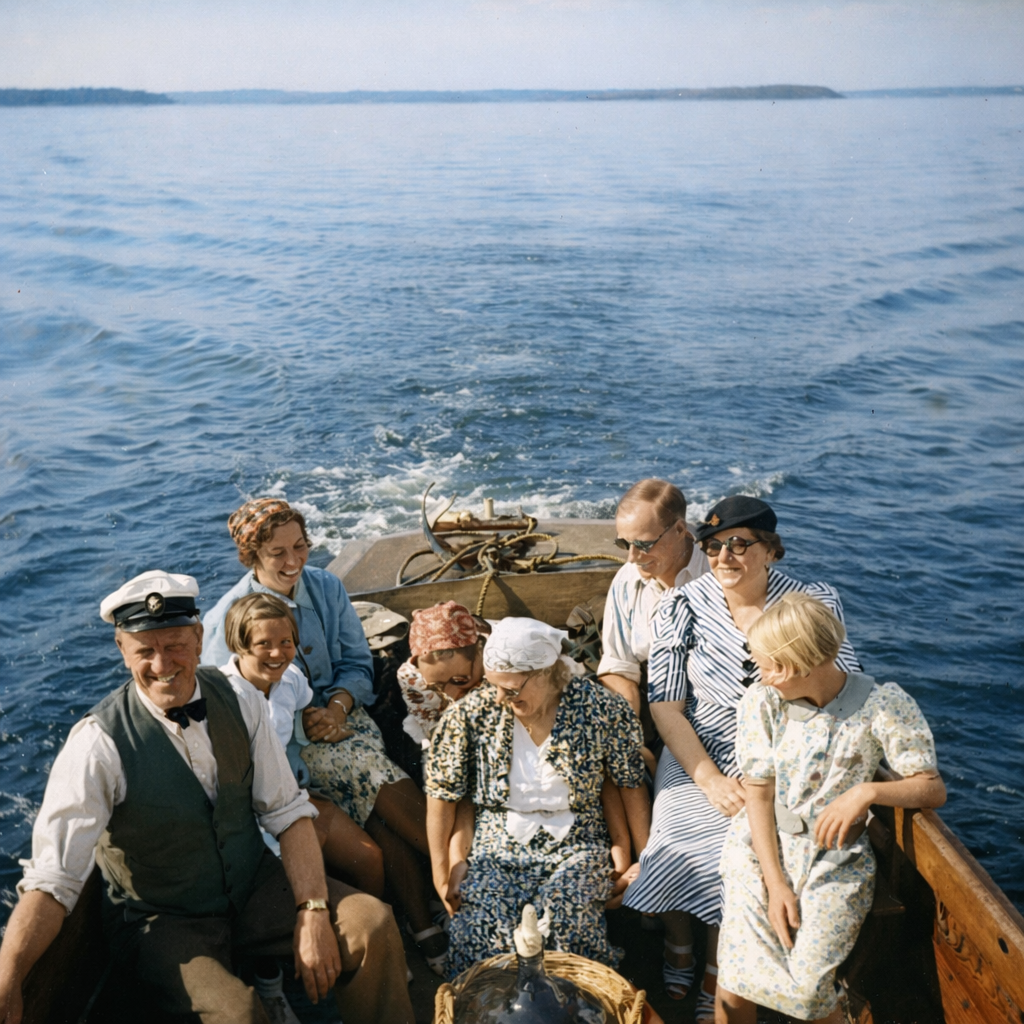
The childhood memories from the island are vivid – the swing by the beach, the encounter with a seal in the moonlight, and summers filled with adventure.
Filip and Agda take over – 1930
In 1930, the master painter Filip Johansson and his wife Agda ”Filippa” Johansson bought Marieskär. At that time, formal permission was lacking, but this was arranged in 1932.
Filip expanded the cabin with the help of family and friends: a kitchen, living room, veranda, and a root cellar were added. On a rock plateau, he created a gathering place with a view of the sunset – called ”the cinema”.
On a door, he painted the text:
Welcome to this cliff
wishes Filip and Filippa
The family lived close to nature. They rowed to Ålö to fetch milk, and fishing provided plenty of food.
Ingvor and Rune – the next generation
In 1953, the daughter Ingvor and her husband Rune Lindberg took over the island. The purchase price was 1,500 kronor – including boat and nets.
Family life on the island was characterized by:
- fishing (perch, eel, cod, salmon, etc.)
- bad, snorkeling and play
- a rich social life with friends and relatives
- midsummer celebrations and cultural elements
Artists such as Valentin Wirf and Leo Janis Brieditis stayed on the island. Rune participated in revues in Nyköping, and the circle of friends often gathered at Marieskär.
In 1971 was written ”The Marieskär Waltz”, a tribute to the place. The same spirit is evident in the humorous initiative ”The Association for the Preservation of Outdoor Toilets in the Outer Archipelago”, with a solemn inauguration and cocoa liqueur as the ceremonial drink.
A memorable episode is when the narrow boat ”Silverpilen” arrived. One of the passengers, ”Snus-Ernst,” wrote in the guestbook:
”Ho ä rar, I stay.
Development and change
In the 1960s, a boathouse and pier were built. During the 1980s, the cottage was renovated – a new roof and tile replaced the old tar paper roof.
After Rune's passing in 1981, Ingvor continued to care for and develop the island.
New generations
In 1989, Ingvor transferred Marieskär to his sons Lasse and Andreas.
During the 1990s and 2000s, development continued:
- new buildings were erected
- piers and terraces were constructed
- the families grew
In 2009, Ingvor passed away, having documented the island until the end.
Today – the fourth generation
Since 2019, Marieskär is run by the fourth generation:
- Ida, John, and Martin (Lasse's children)
- Hannes and Albin (Andreas's children)
The island continues to thrive as a place for family, history, and tradition – where memories from several generations are still present on every rock, path, and pier.